About the artist
At the end of 1991, I felt I needed to do something new. Looking through a book of pastel landscapes by Degas, and this one in particular, convinced me to try pastels myself, although I knew nothing about them. Marking paper with a pastel seemed straightforward and a few pieces of chalk with a little paper were a cheap experiment. I had not had any art training but working with pastels turned out to be less frustrating than I expected. Here’s my first attempt, a house sparrow in the snow in the backyard.

I was lucky to start with soft pastels. Unlike watercolors, they are opaque – notice the white over dark brown at the top – so a mistake can be erased or brushed away and drawn over if the paper will stand up to it. Because of this opacity, soft pastels don’t blend like paints where blue + yellow = green, so I had to learn to identify colors I saw by name so I could get the particular pastel. Useful eye training. Examples of color naming systems I learned are here and here.
After a year working with soft pastels, I wanted to try oil paints. In the summer of 1993, I built an easel to take outdoors and began. I found that a canvas acts as a sail, so the feet must be staked down. To spend several hours outdoors in a place that touches you, looking and looking and trying to mix the colors you see and sketch what caught your eye—this is a profound delight. I often used these paintings or pencil drawings in the studio (upstairs bedroom) as the basis for pastel paintings.
I kept working in the evenings and weekends and summers, and had a few shows over the next couple of years, listed below. But by 1997, I had no time outside of work and set all my art materials aside. It was hard to stop. I had a recurring dream in which I remembered that I owned a neglected boarded-up cabin in a field at the edge of the woods, and had not been inside for years. I retired in 2014 and feel very fortunate to have time to paint again.
But things change. Almost all the places I went to paint twenty years ago have become housing or office developments or the wetlands have dried and grown over with thickets. On the other hand, digital photography, raw photo files, and large high-resolution monitors provide much easier access to photographs without the dust issues and expense of film and enlargements. And I have a studio now, half a mile from home.
I now work from my photographs in their raw version, which retain complications and details forgotten or smoothed away in sketches and memory. In 2015, for example, I visited one prairie every month to take photographs. In painting from a photograph, I try to match the colors I see, not heighten them. What occurs in nature is more interesting than what I could invent. I prefer landscapes that are not about some thing, focal point or feature of interest: these narrative elements turn the picture into an illustration for some story.
For plein air painting, on the other hand, I think titanium [white] is vastly superior… I’d just like to add that anyone who disagrees with me on this is wrong. —Marc Dalessio
Notes on materials
Soft pastels became popular in the 1700s because plate glass was newly available and artists could make frames with glass to protect the picture surface. There were other good reasons too; see this interesting history by Marjorie Shelley: The Rise of Pastel in the Eighteenth Century (2011, The Metropolitan Museum).
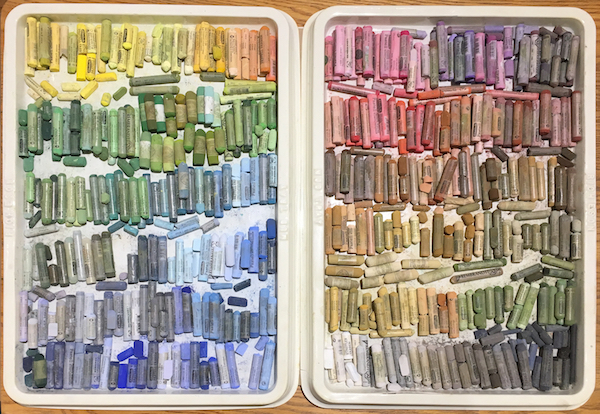
The pastels I work with are mostly from Schminke, with additional greens from Unison, greens and grays from Rembrandt. The paper is Arches Cover (Velin d’Arches) cotton paper; they now make a sized version for oil paint.
For oil paints, Old Holland; brushes, Silver. I used to get rolls of linen canvas from New York Central Art Supply, which sadly closed in September 2016 after a rent increase.
Exhibits
Solo shows:
8-9 June 2019 Open Studio oils on linen, Minneapolis Minnesota
5-6 November 2016 Open Studio pastels on paper, Minneapolis Minnesota
Oct–Nov 1996 Dorothy Berge Gallery of Contemporary Art, Stillwater, Minnesota
Group Shows:
Holiday Show, December 1998, Dorothy Berge Gallery of Contemporary Art, Stillwater, Minnesota
Minneapolis 55408, July 1998, Intermedia Arts, Minneapolis
5th Anniversary Show, Oct–Nov 1997, Bridge Square Gallery, Northfield, Minnesota
Holiday Show, December 1996, Dorothy Berge Gallery of Contemporary Art, Stillwater, Minnesota
Northern National Juried Show 1995, Northern Arts Council and Nicolet College Gallery, Rhinelander, Wisconsin
 Will Thomas - Paintings
